Choosing a laptop stand comes down to three things: how much lift you need to bring the top of the screen to eye level, whether your setup ever changes (different chairs, standing, travel), and whether the stand fits your laptop's size and weight with room to spare. Measure those first and the right stand usually picks itself; skip them and you end up with a riser that is too low, too wobbly, or too big for your bag.
Want our ranked shortlist? See the best laptop stands.
Our review page covers the basic stand types and why you need an external keyboard. This guide goes further: how to work out your exact lift in a couple of minutes, how to read capacity and size specs, and where buyers most often go wrong.
What to Measure Before You Buy#
The lift you actually need#
Sit in your usual chair at your usual height, back against the backrest, looking straight ahead. Measure from the desk surface up to your eye level. Then open your laptop on the desk and measure from the desk to the top edge of the screen. The difference between the two numbers, minus an inch or two, is roughly the lift you need, because the goal is the top of the screen at or slightly below eye level so your gaze drops a little toward the center.
For many people sitting at a standard desk, that gap comes out around 5 to 7 inches. That is why so many fixed risers land in that range: the Rain Design mStand lifts the screen 5.9 inches, the Twelve South Curve and SOUNDANCE about 6 inches, and the Nulaxy C3 about 7 inches. If your number falls well outside that range, a fixed riser is a gamble and an adjustable stand is the safer buy.
If you wear bifocals or progressive lenses, set the screen a little lower than the rule suggests, since you read through the bottom of the lens.
Viewing distance and desk depth#
A raised laptop still needs to sit about an arm's length away, roughly 20 to 30 inches from your eyes. Add the stand's footprint and an external keyboard in front of it, and a shallow desk fills up fast. Measure your desk depth and leave room for the stand, the keyboard, and your forearms. Stands with a keyboard stash area under the front, like the mStand, help on shallow desks because the keyboard can slide underneath when you are not using it.
Laptop size and weight#
Check two specs: the supported screen size and the weight capacity. Size ranges vary: the SOUNDANCE and BESIGN LS03 list 10 to 15.6 inches, the Nulaxy C3 lists 10 to 16 inches, and the Nulaxy C1, BoYata N21, and Nulaxy C5 go up to 17 inches. The mStand is sized mainly for MacBooks and laptops around 15 inches. Capacity ranges from 8.8 pounds on the SOUNDANCE and BESIGN to 22 pounds on the Nulaxy C1, C3, and C5. Most laptops weigh far less than any of these limits, but a higher capacity usually signals a stiffer frame, which matters if you ever press on the screen or type on the built-in keyboard.
How you will use it#
Answer three questions honestly. Does the stand stay on one desk forever? Do you ever stand while working? Do you carry your laptop between home, office, and cafes? Those answers map directly onto the four types of stand.
The Decision Axes and Trade-offs#
Fixed versus adjustable#
A fixed riser has no joints, so it is the most rigid design and often the most elegant. The trade-off is that you accept its one height. An adjustable stand lets you set your exact number and change it when your chair, desk, or user changes, but every hinge or shaft is a point that can flex. Dual-shaft designs like the Nulaxy C1, with seven height levels from 3.15 to 10.6 inches, add range while keeping the frame steady.
Range versus convenience#
Adjustable stands differ in how you change height. Multi-level shaft stands give you a wide range but usually take two hands. The BoYata Push-Button stand trades range (3.9 to 7.4 inches) for one-hand, push-button adjustment, which is easier if you change height several times a day.
Seated only versus sit-stand#
A normal stand cannot reach standing eye level. A sit-stand converter like the Nulaxy C5 adjusts from 1.2 to 20 inches with a pull handle, turning a fixed desk into a part-time standing desk. The cost is a bigger, heavier unit, and the C5 lists no height lock button, so it is less suited to heavy pressure on the screen.
Portable versus permanent#
Travel stands fold small and weigh little, but give up the solid feel of a desk stand. The Roost V3 folds to a stick and still lifts the screen 6.5 to 12.5 inches, which is enough for real eye level on the road. Heavy designs like the alloy-steel, Z-type BoYata N21 are the opposite: steady and adjustable, but not something you want to carry.
Material and airflow#
Aluminum frames act as a passive heat sink and feel planted; open or U-shaped designs leave the underside exposed for airflow. Steel is heavier still. Plastic is lighter and cheaper but does little for heat. If your laptop throttles under load, favor open aluminum.
Budget Tiers: What You Gain as You Move Up#
Budget. Detachable, fixed-height aluminum risers that lift a laptop about 6 inches. You gain eye-level height, airflow, and easy storage. You give up adjustability, and some budget models have lower weight limits.
Mid-range. Multi-level adjustable aluminum stands and push-button designs. You gain your own exact height, wider laptop size support, and higher capacity. You give up a little rigidity compared with a one-piece riser.
Premium. Single-piece cast aluminum, sit-stand converters, and engineered travel stands. You gain either the steadiest, best-finished desk stand, a standing-height range, or a full-height stand that fits in a bag. You pay for build quality or a specialized job, not for better posture than a well-set mid-range stand.
Common Mistakes#
Buying the stand without a keyboard and mouse. Once the screen is at eye level, typing on the built-in keyboard puts your wrists and shoulders in a bad spot. Budget for an external keyboard and mouse at the same time.
Guessing the height. Measure first. A fixed riser that ends up an inch or two too low still leaves you looking down all day.
Buying for a bigger laptop later and forgetting the capacity. If you might move to a 16- or 17-inch machine, check that both the size range and weight limit cover it now.
Choosing a travel stand for a permanent desk. Lightweight folding stands flex more under typing pressure and touchscreen taps. If the stand never leaves your desk, buy for stability.
Blocking the vents. A solid riser or one that covers the intake area can make a laptop run hotter than sitting flat. Check where your laptop takes in air and choose an open frame that leaves those areas exposed.
Forgetting cables. A raised laptop needs its power and USB cables to reach. Stands with a cable hole or open back keep cables from tugging the laptop sideways.
Picks by Need#
For a permanent desk that never changes. The Rain Design mStand is a single piece of aluminum that doubles as a heat sink, lifts the screen 5.9 inches, and adds a cable hole and keyboard stash. It is for MacBook and roughly 15-inch laptop owners whose seating stays the same.
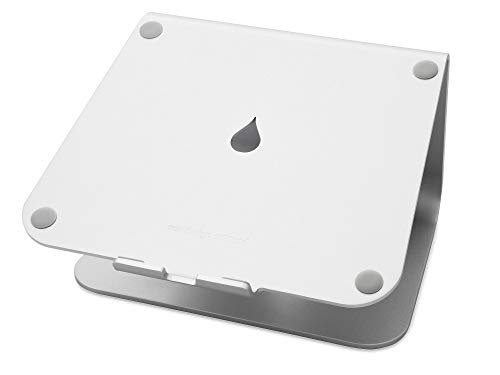
Rain Design mStand Laptop Stand
Editor’s ChoiceA premium single-piece aluminum stand that doubles as a heat sink, raising the screen 5.9" to eye level, with a cable-management hole and a keyboard stash area — a timeless desk design.
For setting your own height on a budget. The Nulaxy C1 is a dual-shaft aluminum stand with seven levels from 3.15 to 10.6 inches, laptops from 10 to 17 inches, and a 22-pound capacity. Choose it if your measured lift does not match a fixed riser.

Nulaxy C1 Laptop Stand
Best ValueA highly rated dual-shaft aluminum laptop stand with 7-level height adjustment (3.15"–10.6"), built-in heat ventilation, silicone scratch protection, and tool-free adjustment.
For frequent height changes. The BoYata Push-Button stand adjusts from 3.9 to 7.4 inches with one hand and sits on dual 3mm metal base plates. It suits shared desks and anyone who changes position through the day, within its 11-pound load limit.

BoYata Push-Button Laptop Stand
A U-shaped aluminum stand with push-button height adjustment (3.9"–7.4"), dual 3mm metal base plates, 8 rubber pads for grip and scratch protection, and improved airflow.
For working from more than one place. The Roost V3 folds compact and lifts the screen 6.5 to 12.5 inches on a rigid truss frame. Pick it if you work from cafes, hotels, or co-working spaces and still want real eye-level height.

Roost V3 Portable Laptop Stand
Premium PickAn ultra-portable, height-adjustable laptop stand that folds to a stick and lifts the screen 6.5 to 12.5 inches — the travel pick for working from cafés, hotels, and co-working spaces.
For alternating sitting and standing. The Nulaxy C5 adjusts from 1.2 to 20 inches with a retractable pull handle and a 22-pound capacity. It is for a fixed desk where you want standing time without buying a standing desk.

Nulaxy C5 Sit-Stand Laptop Stand
A versatile sit-to-stand converter adjusting from 1.2" to 20" with a retractable pull handle, aluminum build with ventilation holes, rubber safety edge-stoppers, and a 22 lb capacity.
FAQ#
How high should a laptop stand be?#
High enough that the top edge of the screen sits at or just below your eye level while you sit upright. Measure from your desk to your eyes, subtract the height of the top of your open screen, and take off an inch or two. For many people at a standard desk that works out to roughly 5 to 7 inches of lift, but your chair height and torso length can push it outside that range.
Can a laptop stand hold a 17-inch laptop?#
Many can, but check the listing. Stands like the Nulaxy C1, BoYata N21, and Nulaxy C5 list support for laptops up to 17 inches, while several fixed risers stop at 15.6 or 16 inches. Look at the weight limit too, and choose a stand whose limit sits comfortably above your laptop's weight.
Is it safe to type on a laptop that is on a stand?#
Light typing is fine on most stands, but it is not comfortable or ideal. The raised keyboard bends your wrists, and pressure on an elevated laptop makes lighter stands flex. For long sessions, use an external keyboard. If you must type on the built-in keyboard, lower the stand or tilt it only slightly.
Should I buy a laptop stand or an external monitor?#
They solve different problems. A stand fixes screen height for the laptop you already have, at low cost and with no extra desk clutter. An external monitor adds a bigger screen at eye level, with the laptop either closed or used as a second display. Many people start with a stand and keyboard, then add a monitor later and keep the stand to raise the laptop beside it.
When you are ready to compare specific models, see our ranked list of the best laptop stands.