The short answer: do not stand all day. The goal is not to replace sitting with standing, it is to keep changing posture. Aim to switch positions every 30 to 60 minutes rather than holding either one for hours. A practical starting point most people can sustain is about 30 minutes of standing per hour of work, then adjust up or down based on how your legs, feet, and back feel.
If that ratio sounds vague, that is on purpose. The research does not point to a single magic number, and your ideal split depends on your body, your shoes, your floor, and the task in front of you. What the evidence does agree on is the principle: the healthiest position is your next one. A standing desk is a tool for movement, not a license to trade one static posture for another.
Why Standing All Day Is Its Own Problem#
When standing desks first got popular, the pitch was simple: sitting is bad, so stand instead. The reality is more nuanced. Prolonged standing carries its own well-documented downsides, and people who switch to standing for six or eight hours straight often feel worse, not better.
Standing for long stretches loads your lower back, knees, hips, and the small joints of your feet. It also makes your leg muscles work statically to hold you upright, which is more fatiguing than it sounds. Over months and years, prolonged standing without relief from walking lets blood pool in the legs and feet, which occupational health guidance links to leg swelling, sore feet, low back pain, and eventually varicose veins (Canadian Centre for Occupational Health and Safety).
The fatigue matters for a second reason: tired people slump. After a couple of hours on your feet, you start leaning on the desk, locking your knees, or shifting all your weight onto one hip. That is no better than slouching in a chair. The takeaway is not that standing is dangerous, it is that any single posture held too long is the problem. This is the same conclusion we reached when comparing the two setups directly in standing desk vs sitting desk.
The Evidence-Backed Cadence and Ratios#
The clearest message from ergonomics research is about cadence, not totals. Guidance for office workers generally favors changing position at least every 30 to 60 minutes; Cornell's widely quoted pattern, for example, cycles through sitting, standing, and moving within every half hour, and warns that too much standing can be harmful in the same way as too much sitting (Cornell University Ergonomics Web). For daily totals, an international expert statement in the British Journal of Sports Medicine recommends that desk workers start by accumulating about 2 hours of standing and light activity during working hours, progressing toward about 4 hours over time (Buckley et al., 2015).
For the sit-to-stand split itself, a reasonable range is anywhere from 1:1 to 2:1 sitting-to-standing. In plain terms, for every hour you stand, sit for one to two hours. If you work a 6-hour focused block, that lands you somewhere around 2 to 3 hours of standing spread across the day, never in one continuous shift.
Two details make the ratio work better than the raw number:
- Break standing into short bouts. Three 20-minute stands are generally easier on your legs and feet than one 60-minute stand.
- Add light movement, not just static standing. Shifting weight, taking a few steps, or pacing during a call does more for your legs than standing rigidly. This is why an under-desk treadmill pairs so naturally with a standing desk.
Do not get precise to the minute. The ratio is a guardrail, not a stopwatch drill.
A Simple Starting Schedule and How to Ramp Up#
If you are new to standing, start conservatively. Going from a full day of sitting to several hours of standing in week one is the fastest way to sore feet and a desk you abandon.
A workable first-week schedule looks like this:
- Stand for 15 to 20 minutes at the top of each hour, then sit for the rest.
- That totals roughly 90 to 120 minutes of standing across an 8-hour day.
- Sit back down the moment you feel discomfort, not when a timer says to.
Over the next 2 to 4 weeks, extend each standing bout toward 30 minutes and let your daily total climb to 2 or 3 hours. A common, comfortable steady state is about 30 minutes standing per hour, but plenty of people settle higher or lower. Let comfort and focus set the ceiling, not a target you read online.
Tie posture changes to natural breakpoints in your day: stand when a meeting starts, sit when you move into deep writing, stand again to read or review. Anchoring the switch to a task makes the habit stick far better than a reminder you learn to ignore.
Signs You Are Standing Too Long or Too Little#
Your body gives reliable feedback. Learn to read it.
Signs you are standing too long:
- Aching or burning feet, or the urge to lean on the desk.
- Locked knees or shifting all your weight to one leg.
- Lower-back tightness that eases the moment you sit.
- Swelling or heaviness in your lower legs by late afternoon.
When you notice these, sit down. Pushing through fatigue trains bad posture and sours you on the whole setup.
Signs you are standing too little:
- You realize you have been seated for 2-plus hours without moving.
- Stiffness in your hips or upper back when you finally get up.
- Afternoon energy crashes that improve when you move.
The fix in both directions is the same: change position sooner and more often. If you are constantly fighting one extreme, your interval is too long.
Why Most People Quit, and How to Make the Habit Stick#
Knowing the right ratio is the easy part. Plenty of people who buy a sit-stand desk drift back to sitting full-time within a few weeks, and the desk quietly becomes a regular desk that cost more than it needed to. Three things kill the habit, and they usually show up together.
- Too much, too soon. Standing for four hours on day one leaves your feet aching and your lower back tight, and by day three you associate standing with discomfort. The problem was the dose, not the standing.
- Plain discomfort. Hard floors and flat shoes make long stretches genuinely tiring, and fatigue is a strong signal to sit back down and stay down.
- No trigger. Sitting is the default and nothing in your day prompts you to change it. A habit with no cue is just a wish.
The fix for the last one is habit stacking: attach standing to moments that already happen several times a day, so you never have to remember. Good anchors include:
- Every phone or video call. You are not typing, and standing often makes you sound more energetic.
- Coming back from lunch. The break already interrupts your sitting, so make it the switch point.
- Starting a fresh task or opening a new document. The mental reset pairs well with a physical one.
After a week or two, the call itself becomes the reminder and you raise the desk without deciding to. Treat discomfort as information rather than failure: when something feels off, sit down. Alternating freely is the whole point, and listening to your body is what keeps the routine sustainable instead of punishing.
Tools That Help You Actually Do It#
The biggest predictor of whether you keep a sit-stand routine is friction. The easier it is to switch, the more often you will. A few tools remove the excuses.
- Height presets. A desk with one-touch memory positions for sitting and standing turns a posture change into a single button press. Without presets, it is easy to stop adjusting altogether. You can see which models do this well in our standing desk reviews.
- Movement reminders. A simple recurring timer, a phone alarm, or your watch nudging you every 30 to 45 minutes is enough. The goal is a prompt, not a rigid schedule.
- An anti-fatigue mat. This is the highest-value, lowest-cost addition for standing. A cushioned mat encourages micro-movements in your feet and calves, and occupational safety guidance recommends mats for anyone standing on hard floors (CCOHS).
- A walking pad or under-desk treadmill. For calls, reading, and email, slow walking at 1 to 2 mph adds genuine movement without breaking focus. It turns standing time into active time, and walking is exactly the kind of relief that keeps blood from pooling in your legs.
You do not need all of these. A desk with presets and a good mat covers most people. If you are still shopping, an electric desk with memory presets like this one makes each switch a single button press.
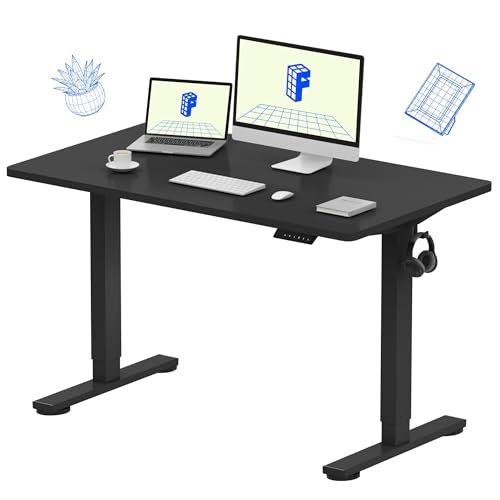
FlexiSpot EN1 Standing Desk 48×24
The FlexiSpot EN1 pairs a seamless one-piece desktop with quiet electric height adjustment and 4 memory presets — rock-solid, wobble-free stability that handles dual monitors with ease.
Add a walking pad only if you want to convert passive standing into active movement. A slim pad that slides under the desk when you are done keeps it from taking over the room.

Sunny Health & Fitness Treadpad 100 (SF-T724064)
Editor’s ChoiceOne of the most popular walking pads, with a large owner base. A no-assembly, slide-under-the-desk slab with Wi-Fi and Bluetooth SunnyFit app tracking, a 41-inch deck, shock-absorbing cushioning, and a remote — the safe default for a home office.
The Bottom Line#
There is no perfect number, but there is a clear principle: keep moving. Change posture every 30 to 60 minutes, aim for a sit-to-stand ratio somewhere between 1:1 and 2:1, and treat about 30 minutes of standing per hour as a starting point you adjust to comfort. Ramp up gradually over a few weeks rather than overhauling your day at once.
Standing all day is not the goal and never was. The goal is to break up long stretches of stillness, in either direction. Get the cadence right, lean on presets and an anti-fatigue mat to lower the friction, and let your body, not a stopwatch, set the pace.