The debate between standing desks and sitting desks has been going on for years, and the answer is more nuanced than most headlines suggest. You've probably heard that "sitting is the new smoking" — but spending your entire workday standing isn't a cure-all either. Let's look at the actual science and help you make an informed decision.
The Case Against Prolonged Sitting#
Research consistently links excessive sitting with a range of health risks. A 2015 meta-analysis in the Annals of Internal Medicine found that more sedentary time was associated with higher risk of cardiovascular disease, type 2 diabetes, cancer, and all-cause mortality, even after adjusting for physical activity — although the associations were weaker in people who were more active (Biswas et al., 2015).
The mechanism is straightforward: when you sit for extended periods, large muscle groups (especially in your legs and core) go essentially dormant. Blood pools in the lower extremities, glucose metabolism slows, and the spine absorbs compressive forces in a way it was never designed to handle continuously. The result is not just back pain — it's systemic metabolic stress.
For the average knowledge worker sitting 6–8 hours a day, these risks are real. The question is whether a standing desk actually solves them.
What the Research Says About Standing Desks#
Standing desks have been studied more rigorously in the last decade, and the results are encouraging — but with important caveats.
A 2018 Cochrane review of 34 studies found that sit-stand desks reduced sitting at work by roughly 100 minutes per workday in the short term (Shrestha et al., Cochrane Database of Systematic Reviews). The caveat: the authors rated the evidence as low quality, and there is little data on what happens over longer periods, so claims about big long-term health payoffs are still ahead of the research.
Another important point: standing continuously brings its own problems. Occupational health guidance links prolonged standing to sore feet, leg swelling, muscle fatigue, and low back pain, and over time to varicose veins (Canadian Centre for Occupational Health and Safety). The answer isn't to swap one extreme for another.
The Verdict: Alternation Is the Strategy#
The current consensus from occupational health researchers is clear: the goal is movement variation, not simply standing more. The ideal workday alternates between sitting, standing, and brief movement breaks. Most ergonomics guidelines suggest moving every 30–45 minutes as a baseline.
This is where height-adjustable desks shine. They give you the ability to shift posture throughout the day without disrupting your workflow. The best electric sit-stand desks make transitions effortless — raising and lowering in seconds with programmable presets.

FlexiSpot E6 Bamboo Standing Desk 55×28
A premium FSC-certified solid-bamboo desktop (stronger than steel by tensile strength) with dual motors, 45dB whisper-quiet operation, 220 lb capacity, a 23.6"–49.2" height range, and a 5-year frame/motor warranty.
The FlexiSpot E6 Bamboo is a standout choice for anyone ready to commit to an adjustable setup. Its dual-motor frame stays stable at standing height, the solid bamboo top is a real upgrade over particleboard, and the 5-year warranty reflects genuine build quality. If you work long hours, the ergonomic ROI pays for itself.
Productivity: Does Your Desk Type Actually Matter?#
The research on productivity is more mixed. Standing doesn't appear to boost creative or complex cognitive work in most studies. However, removing discomfort — whether from poor posture or a nagging backache — does tend to improve focus and reduce mental fatigue.
The productivity argument for sit-stand desks isn't that standing supercharges your brain; it's that chronic discomfort from poor ergonomics saps your concentration over time. Workers who can control their environment tend to feel more in command of their workday, which correlates with job satisfaction and sustained output.
Pairing a good adjustable desk with a properly fitted ergonomic chair is the more powerful move. Sitting time isn't going away entirely, so investing in a chair that supports good posture during those seated hours is just as critical as the desk itself.
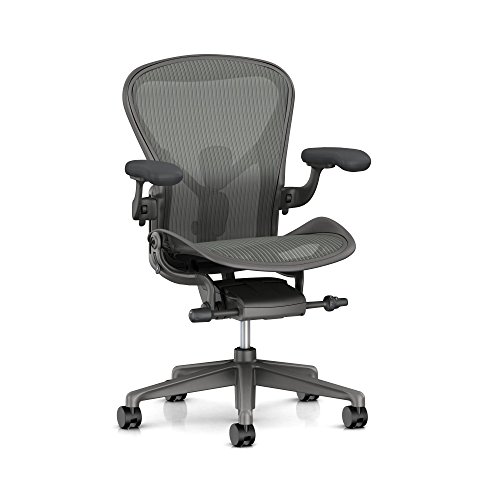
Herman Miller Aeron
Editor’s ChoiceThe Herman Miller Aeron is the definitive ergonomic chair — a 30-year-old design that still sets the benchmark for lumbar support, breathability, and long-session comfort.
The Herman Miller Aeron has long been considered the benchmark for ergonomic seating. Its PostureFit SL lumbar support, adjustable armrests, and breathable mesh keep you comfortable through long seated sessions without the heat buildup and pressure points of foam chairs. When you do sit, make it count.
Cost Considerations: Is a Standing Desk Worth the Price?#
A quality height-adjustable desk typically costs roughly two to three times as much as a comparable fixed-height desk. That's a meaningful price difference. Here's how to think about it:
If you work from home full-time: The investment makes clear sense. You're at your desk 30+ hours a week, and the ergonomic benefits compound over years.
If you're in a hybrid arrangement: Consider your actual daily hours at home. If you're only at your home desk 2–3 days a week, a premium standing desk is harder to justify immediately. A converter that sits on top of your existing desk is a lower-commitment way to try a sit-stand routine.

VIVO 32" Standing Desk Converter (DESK-V000K)
Best ValueA sit-stand converter that sits on your existing desk: a 31.5-inch top with a separate keyboard tray, gas-spring lift for up to 33 lbs, and 4.5 to 20 inches of height adjustment — no new desk required.
If you're dealing with existing back pain: The case for an adjustable desk becomes stronger. Many people report relief within weeks of switching to a sit-stand routine.
Also factor in the hidden costs of inaction: chiropractic visits, physiotherapy, and lost productivity from chronic pain are real expenditures that don't show up on a product comparison spreadsheet.
Setting Up Your Ideal Ergonomic Workstation#
Whichever desk type you choose, ergonomic setup matters enormously. Here are the fundamentals:
Seated position: Elbows at roughly 90 degrees when typing, monitor top at or slightly below eye level, feet flat on the floor or a footrest. Screen should be about an arm's length away.
Standing position: Same elbow angle applies. Most people stand too high — your keyboard shouldn't require you to hunch your shoulders. Use an anti-fatigue mat to reduce foot and leg strain.
Monitor placement: A monitor arm gives you flexibility for both positions and eliminates neck strain from fixed monitors that are too low.
Transition habits: Try a 20/20 rule as a starting point — 20 minutes sitting, 20 minutes standing. Adjust based on what your body tolerates. Some people do well with longer sitting blocks; others prefer to stand first thing in the morning.
Common Questions#
Is it better to sit or stand while working? Neither extreme wins; alternating does. Sitting all day is linked to more back and metabolic problems, but standing all day brings its own issues like leg fatigue, foot pain, and circulation strain. The evidence points to a height-adjustable desk used to switch positions, and more importantly to moving regularly. Aim to change posture every 30 to 60 minutes rather than to maximize standing.
How long should you stand at a standing desk each day? There is no official number, but a common evidence-informed target is roughly a 1-to-1 to 2-to-1 sitting-to-standing ratio across the day, built from short blocks rather than one long stand. Start with something sustainable, like 20 to 30 minutes of standing per hour, and adjust to what your legs and back tolerate. The goal is frequent transitions, not a standing marathon.
Does a standing desk burn significantly more calories? Only modestly. A meta-analysis of 46 studies put the difference at about 0.15 calories per minute, or roughly 9 extra calories per hour versus sitting (Saeidifard et al., European Journal of Preventive Cardiology), so it is not a weight-loss tool on its own. The real benefits are posture variation, less stiffness, and staying more active. If fat loss is the goal, a walking pad under the desk moves the needle far more than standing still.
Is standing all day bad for you? Yes. Prolonged standing carries its own risks, including leg and foot fatigue, lower-back strain, and circulation issues over time, which is why standing-only setups tend to fail. The healthiest pattern is alternating sitting and standing, using an anti-fatigue mat, and taking regular short walks, rather than trading one static posture for another.
The Bottom Line#
There is no single correct answer to "standing desk or sitting desk." The sitting-only setup is a clear ergonomic liability for people who work long hours. A standing-only setup is unrealistic and creates its own problems. A height-adjustable desk used intelligently — with deliberate transitions and breaks — is the most evidence-based approach.
The best desk isn't the one that makes you stand more. It's the one that makes it easy to move more, sit well when you sit, and stand comfortably when you stand. Combined with a quality ergonomic chair, a good monitor setup, and a few minutes of movement every hour, you'll feel a meaningful difference within weeks.