Picking a surge protector for a desk comes down to three things: proof that it is a real surge protector (a UL 1449 listing and a printed voltage protection rating, not just the word "surge" on the box), enough usable outlets and USB power for the gear you actually own, and a cord, plug, and load rating that suit where it will live. The joule number matters too, but it is only one line on a label that tells you much more if you know how to read it.
Want our ranked shortlist? See the best power strips and surge protectors.
Read the Label Before the Box Art#
Every legitimate surge protector carries a small block of ratings, usually on the back or bottom of the unit and on the packaging. Here is how to read it.
UL 1449 Listing and Safety Marks#
In the US, surge protective devices are tested to UL 1449. A unit listed to that standard will show a mark from a nationally recognized testing lab: UL, ETL (Intertek, which tests to the same UL standards), or another recognized lab such as TÜV. The HANYCONY strip and Kasa HS300 list ETL certification; the Anker 351 lists a TÜV mark. Watch the wording: "UL listed" means the whole product was tested, while "UL recognized component" or "meets UL standards" can mean only a part was tested, or nothing at all. No mark from a recognized lab is a reason to walk away.
Voltage Protection Rating#
The voltage protection rating, or VPR, is the voltage a protector lets through to your gear during a standardized surge test. Lower is better. The best rating under UL 1449 is 330 volts, followed by 400 and 500. Many good desk strips list 330 or 400 volts somewhere on the label. A unit that lists joules but hides its VPR is telling you only half the story; joules tell you how much the protector can absorb over its life, while VPR tells you how much a spike gets through to your gear.
Joules#
Joules measure total energy absorption before the protective parts wear out. The higher the number, the longer the protector keeps working as it absorbs surges over the years. For context on the units covered here, the Amazon Basics 6-outlet strip is rated at 1000 joules, the Mifaso 10-foot strip at 1080 joules, the Anker 8-outlet at 2000 joules, the Anker 351 at 2100 joules, and the Belkin 12-outlet at 4,320 joules. Use joules to compare two units that already pass the listing and VPR checks, not as the only number you look at.
Protection Modes#
Better protectors list protection across all three wire pairs: line to neutral, line to ground, and neutral to ground. That covers surges that show up between any two conductors. If a label lists only one mode, the protection is narrower than the joule figure suggests.
Indicator Lights#
Look for two lights: one that confirms surge protection is still working and one that confirms the outlet is properly grounded. Surge protectors need a ground to divert excess energy, so a unit plugged into an ungrounded or two-prong adapter offers little protection. The protection light matters because protective components wear out silently; when that light goes off, the strip may still power your gear while protecting nothing.
Plan Your Outlets and Power#
Count Plugs, Then Bricks#
List every device that will plug in, then mark which ones use a bulky wall adapter. A typical desk has a monitor or two, a laptop charger, a dock, a lamp, speakers, and a phone charger. Bricks block neighboring outlets on tightly packed strips, so the useful outlet count is what matters. Look for spacing like the 2.2 inches between outlets on the HANYCONY strip, or rotating outlets like the eight that pivot on the Belkin 12-outlet unit.
Check the Load Rating#
Most US desk strips are rated at 15 amps, about 1,800 watts at 120 volts, and some lighter-cord units are rated lower. A desk full of electronics rarely comes close, but space heaters, mini fridges, and some laser printers draw a lot of power and do not belong on a desk strip. Add up the wattages printed on your gear if you run a high-power desktop PC with multiple monitors.
Size USB Power to Your Devices#
Built-in USB ports can replace loose chargers, but only if the wattage fits. Roughly: around 20 watts of USB-C charges a phone quickly, around 30 to 45 watts handles a tablet or a small laptop slowly, and 65 watts or more is what most thin laptops need for full-speed charging. The catch is shared output. The Jgstkcity clamp strip has four 20-watt USB-C ports but a 40-watt total, and on the Anker 351 the USB-C drops wattage when the USB-A ports are in use. If you want to charge a laptop from the strip, a desktop charging station like the Anker 525, with up to 65 watts shared across its ports, does that job better than most strips.
Cord, Plug, and Mounting#
Measure from the outlet to where the strip will sit and add slack, so the cord never pulls tight. Cords on the units here range from 5 feet (Anker 351, HANYCONY, Anker 8-outlet) to 6 feet (Amazon Basics), 8 feet (Belkin), and 10 feet (Mifaso). A flat or angled plug lets furniture sit close to the wall. Keyhole slots let you mount the strip under the desk, and a desk-edge clamp model puts outlets at hand height.
Surge Protector, Smart Strip, or UPS#
These solve different problems.
Surge protector. Handles spikes. This is the baseline for any desk with a computer and monitor.
Smart strip. Adds per-outlet app or voice control, schedules, and sometimes energy monitoring. The Kasa HS300 switches six outlets individually and tracks energy per outlet. Smart strips are ideal for cutting standby power or switching a whole setup on and off, but check that the surge protection specs meet your bar, since convenience features and protection are separate.
UPS (battery backup). Handles outages as well as spikes. The APC BE650G1 has eight outlets, four of them battery-backed with surge protection and four surge-only. A UPS gives a desktop PC time to save work and shut down during a power cut. Plug only essentials into the battery side; printers and other high-draw gear belong on the surge-only side, and APC advises against plugging a surge protector or power strip into a UPS.
Budget Tiers#
Budget. Basic surge strips with six to eight outlets, around 1000 joules, and slow USB-A charging. You get real surge protection for a light desk setup. You give up outlet spacing, fast USB-C, and joule headroom.
Mid-range. Eight to twelve outlets, about 2000 joules, a flat plug, spaced or rotating outlets, and USB-C. You gain room for chargers, higher absorption capacity, and a connected-equipment warranty from established brands.
Premium. Heavy-duty protectors above 4000 joules, smart strips with energy monitoring, and battery backup units. You gain more headroom, automation, or outage protection. Read the warranty terms carefully; connected-equipment warranties often require registration and proof of proper installation.
Common Mistakes#
- Daisy-chaining strips. Plugging one power strip into another is a fire risk and is prohibited by safety codes and by manufacturers. Buy one strip with enough outlets instead.
- Trusting "surge" on the box. Without a recognized lab listing and a printed VPR, the label means little.
- Keeping a strip forever. Protective components wear with each surge. Replace the unit when the protection light goes out, after a major surge, or every few years.
- Using an ungrounded outlet. Without a working ground, the surge protector has nowhere to send excess energy.
- Running cords under rugs. Cords under rugs can overheat unnoticed and get crushed. Route them along the wall or under the desk.
- Forgetting other lines. Surges can reach a PC through a network cable or coaxial line too. Some units, including the APC BE650G1, add network-line surge protection.
Picks by Need#
These map to the common situations above. For full rankings, use the review page.
Most single-monitor desks. The Anker 351 pairs 12 AC outlets with 20-watt USB-C and two USB-A ports, 2100 joules, a flat plug, and a TÜV listing. It suits a typical desk that wants one strip for everything.

Anker 351 Power Strip
Editor’s ChoiceThe Anker 351 packs 12 AC outlets plus 20W USB-C fast charging into a flat-plug design with 2100J surge protection, TÜV listing, and a $200,000 connected-equipment warranty.
Lots of chargers and wall adapters. The HANYCONY strip spaces eight outlets 2.2 inches apart and adds two USB-C and two USB-A ports on a braided 5-foot cord. It suits a setup heavy on bricks, though its joule rating is lower than heavy-duty units.

HANYCONY Surge Protector Power Strip
Best ValueA best-value surge strip with 8 widely-spaced outlets, 2 USB-C + 2 USB-A ports, a 5ft braided flat-plug cord, and ETL certification — the highest-reviewed pick on the list.
A full workstation with expensive gear. The Belkin 12-outlet protector offers 4,320 joules, eight rotating outlets, and an 8-foot pivot-plug cord, with no USB ports. It suits multi-monitor setups that want maximum absorption headroom.

Belkin 12-Outlet Surge Protector
A 12-outlet surge protector with 8 rotating/pivoting outlets for bulky chargers, 4,320J of protection, an 8ft flat-pivot cord, and a $300,000 connected-equipment warranty.
Automation and energy tracking. The Kasa HS300 controls six outlets individually by app or voice and monitors energy per outlet, with three USB ports. It suits anyone who wants to schedule gear or kill standby power, provided you have 2.4GHz Wi-Fi.
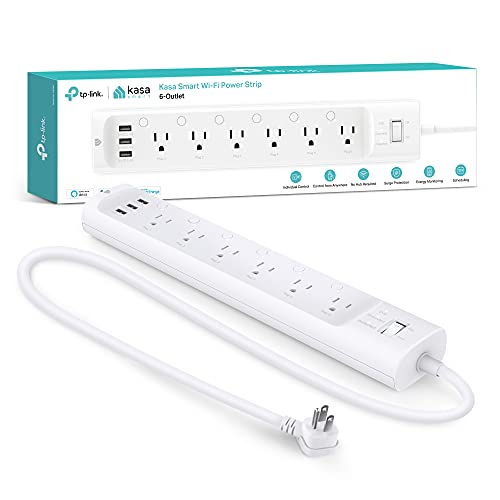
Kasa Smart Power Strip HS300
A Wi-Fi smart strip with 6 individually controlled outlets, energy monitoring, and 3 USB ports — works with Alexa and Google Home, ETL-certified surge protection, no hub required.
Protection against outages. The APC BE650G1 keeps a PC, monitor, and router running through short outages on four battery-backed outlets, with four more surge-only outlets and a user-replaceable battery. It suits desktop PC users who cannot afford to lose unsaved work.

APC BE650G1 Battery Backup UPS
Premium PickA desk-friendly UPS that keeps your PC, monitor, and router running through short outages, with 8 outlets (4 battery-backed with surge, 4 surge-only) and a user-replaceable battery.
FAQ#
What is a good voltage protection rating for a surge protector?#
330 volts is the lowest, and best, VPR under UL 1449, so it means the least voltage passes through to your gear during a surge. 400 volts is also solid for a desk. If a surge protector does not list a VPR at all, treat that as a warning sign and compare it against units that do.
Is a power strip with USB-C enough to charge a laptop?#
Usually not at full speed. Most strips offer around 20 watts of USB-C, which suits phones and earbuds. Thin laptops typically need 45 to 65 watts or more. If you want laptop charging from the desk, look at a charging station with a 65-watt USB-C port, and remember that total output is often shared across ports.
Can I plug a surge protector into a UPS?#
No. Battery backup makers including APC advise against it, because it can overload the UPS and interfere with its protection. Plug devices directly into the UPS outlets, putting essentials on the battery-backed side and everything else on the surge-only side.
How do I know when a surge protector needs replacing?#
Check the protection indicator light; if it is off, the protective components are spent even if the outlets still work. Replace the unit after a major surge such as a nearby lightning strike, and plan to replace a heavily used strip every few years regardless. A warm, discolored, or buzzing strip should be unplugged and replaced right away.
Ready to compare specific models? See our ranked power strip and surge protector reviews, and for hiding the cords afterward, read the cable management guide.