Choosing a mechanical keyboard for work comes down to three things: how much noise your space can tolerate, which layout fits your desk and the keys you actually use, and how the board connects to the computers you work on. Settle those three and the rest, from case material to lighting, is preference.
Want our ranked shortlist? See the best keyboards.
This guide covers the checks to make before you buy, the trade-offs that matter for office typing, what you gain as you spend more, and the mistakes that send people back to their old keyboard.
What to Check Before You Buy#
Your noise budget#
Be honest about where you type. A home office with the door closed can handle almost anything. An open-plan office, a shared room, or a day full of calls cannot. Mechanical boards range from near-silent to loud enough to be picked up by a headset mic, and the switch is only part of it: a hollow case, rattling stabilizers on the space bar, and a hard desk all add sound. If you take many calls, start with quiet switches and a dampened board, and put a desk mat underneath.
Your desk width and mouse position#
Measure from the left edge of where your keyboard sits to where your mouse lives. The wider the keyboard, the farther your mouse arm reaches outward, which loads your shoulder over a long day. A full-size board with a number pad is the widest; a tenkeyless (TKL) board drops the number pad; a 75% board compresses the same keys into a tighter block. If your mouse already feels far away, a narrower layout is the cheapest ergonomic fix there is.
The keys you actually use#
Go through a normal workday and notice what you press. Do you type numbers into spreadsheets for hours? A number pad earns its width. Do you rely on Home, End, Page Up, and Page Down for code or long documents? Make sure the layout keeps them as dedicated keys, not a function-layer combo. Do you use the F-row constantly? Avoid layouts that hide it.
Your computers and operating systems#
Count how many devices you type on. If it's one desktop, a wired board is simplest. If it's a work laptop and a personal computer, a board with multi-device Bluetooth lets you switch with one key. The Logitech MX Mechanical pairs with three devices over Bluetooth or a Logi Bolt receiver.
Then check the OS. Mac and Windows place modifier keys differently. Boards that ship with keycaps for both, like the Keychron K8, let you match the legends to your system. On a Windows-labeled board used with a Mac, you'll want to remap Command and Option in software or swap keycaps.
Your typing height and wrist angle#
Mechanical boards are taller than laptop keyboards. A tall board pushes your wrists into extension, bending them upward, unless your desk or keyboard tray sits a little lower or you add support. Check the board's height on the spec sheet, and if it's a standard-height board, plan for a wrist rest. Low-profile mechanical boards reduce this, at the cost of shorter key travel.
The Decision Axes and Trade-Offs#
Switch feel and switch weight#
Beyond linear, tactile, and clicky, switches differ in how much force they take and where they register. Lighter switches reduce finger effort but make accidental presses easier; heavier switches feel deliberate but tire some typists. If you're unsure, a hot-swappable board lets you change switches later without buying a new keyboard. The Keychron C1 Pro, for example, ships with hot-swappable Super Red linear switches.
Standard height vs low profile#
Standard mechanical boards give deeper travel and the widest choice of switches and keycaps. Low-profile boards like the MX Mechanical feel closer to a laptop, need less wrist adjustment, and are often quieter, but you give up keycap customization and most hot-swap options.
Programmability#
Some boards let you remap any key and build layers. QMK and VIA are open firmware tools that let you do this on boards that support them, such as the Keychron Q1 Pro, and the keymap is stored on the keyboard itself, so it follows you to any computer. Other brands use their own desktop apps. If you rely on custom shortcuts, firmware-level remapping is more portable than software that only runs on one machine.
Polling rate#
Polling rate is how often the keyboard reports to the computer. Higher rates like the C1 Pro's 8000Hz matter to competitive gamers. For typing, any modern board is far faster than your fingers, so don't pay extra for polling rate unless you game.
Budget Tiers: What You Gain at Each Level#
Budget. Plastic cases, wired or simple Bluetooth connections, and decent switches. You get genuine mechanical feel and a big step up from a basic membrane keyboard, but sound can be hollow and stabilizers can rattle.
Mid-range. Better keycaps such as double-shot PBT, hot-swap sockets, multi-device wireless, dual Mac and Windows support, and more refined switches. This is where most office typists should land.
Premium. Aluminum cases, gasket-mounted plates, sound-dampening foam, long-life batteries, and firmware-level programmability. The payoff is a deeper, quieter sound and a heavier board that doesn't slide around, which you'll notice every day if you type for a living.
Common Mistakes to Avoid#
- Choosing switches by sound videos. Recordings exaggerate or flatter sound depending on the mic and room. Weigh office noise first, then preference.
- Buying full-size by default. If you never use the number pad, it just pushes your mouse farther away.
- Ignoring the OS layout. Mismatched modifier keys cost you muscle memory every day.
- Skipping wrist support on a tall board. Standard-height boards angle your wrists up without a rest or a slightly lower surface.
- Paying for gaming features you won't use. Very high polling rates and heavy RGB lighting do nothing for typing.
- Forgetting the space bar. Stabilizer rattle on large keys is one of the loudest parts of a cheap board; it's worth reading owner feedback on it.
Picks by Need#
For a premium, quiet desk board you'll keep for years#
The Keychron Q1 Pro has a gasket-mounted CNC aluminum body in a 75% layout, QMK and VIA support, swappable switches, and Bluetooth 5.1 or USB-C wired with a 4000 mAh battery. The 75% layout drops the number pad.

Keychron Q1 Pro
Editor’s ChoiceThe Keychron Q1 Pro is the best all-around mechanical keyboard — a 75% layout with a gasket-mounted CNC aluminum body, QMK/VIA support, and wireless Bluetooth 5.1.
For an everyday wireless board across Mac and Windows#
The Keychron K8 is a tenkeyless board with Bluetooth across three devices or USB-C wired, a 4000mAh battery, tactile brown switches, and keycaps for both Mac and Windows. Its taller profile pairs well with a wrist rest.

Keychron K8 Wireless Mechanical Keyboard
A tenkeyless wireless board for Mac and Windows: Bluetooth across three devices or USB-C wired, a long-lasting 4000mAh battery, tactile brown switches, white backlight, and an aluminum frame — a reliable everyday keyboard.
For fast typists on a tighter budget#
The Keychron C1 Pro 8K is a wired TKL with hot-swappable Super Red linear switches, double-shot PBT keycaps, QMK and Keychron Launcher support, and 8000Hz polling. Wired only, and no number pad.

Keychron C1 Pro 8K TKL Keyboard
Best ValueAn ultra-fast 8000Hz polling TKL with QMK/Keychron Launcher support, hot-swappable pre-lubed Super Red switches, south-facing RGB, double-shot PBT keycaps, and a 1-year warranty — the best budget Keychron for fast typists.
For shared offices and call-heavy days#
The Logitech MX Mechanical uses low-profile Tactile Quiet switches in a full-size layout, with smart backlighting, USB-C charging, and three-device pairing over Bluetooth or Logi Bolt. You give up hot-swap and keycap customization.
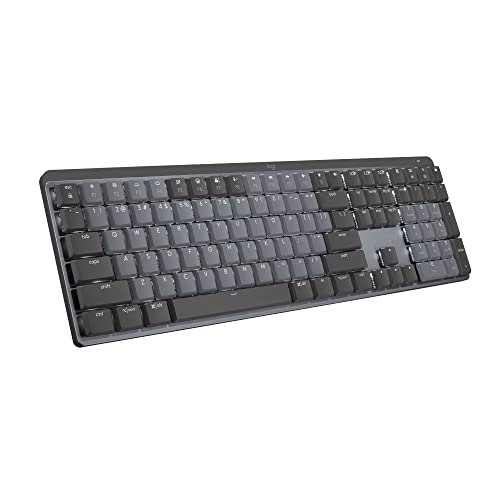
Logitech MX Mechanical Wireless Keyboard
A full-size, low-profile mechanical keyboard with Tactile Quiet switches, smart backlighting, and 3-device pairing — mechanical feel without the office-annoying clatter.
For number-pad users who also game#
The Corsair K70 RGB Pro is a full-size wired board with Cherry MX switches, double-shot PBT keycaps, dedicated media controls, and an aluminum volume roller. It needs a wide desk and has no wireless option.

Corsair K70 RGB Pro
The Corsair K70 RGB Pro is the best full-size mechanical keyboard for users who want dedicated media controls, a numpad, and the proven reliability of Cherry MX switches.
Frequently Asked Questions#
Is a mechanical keyboard worth it just for typing?#
For people who type for hours a day, usually yes. Mechanical switches give a consistent keystroke across every key, are rated for far more presses than a membrane keyboard, and can be replaced or tuned on hot-swap boards. If you type lightly and value silence above all, a low-profile scissor keyboard may suit you better.
Do mechanical keyboards work with Mac?#
Yes. Any USB or Bluetooth keyboard works with macOS. The difference is the modifier layout and media keys. Boards with Mac support, like the Keychron K8 or Keychron Q1 Pro, include Mac keycaps or a Mac mode so Command and Option sit where Mac users expect. On a Windows-only board you can remap the modifier keys in macOS settings.
Are low-profile mechanical keyboards good for typing?#
They're a good fit if you're coming from a laptop or want a lower wrist angle. Key travel is shorter than on a standard mechanical board, so the feel is closer to a laptop, but you still get a defined mechanical actuation. The trade-off is fewer switch and keycap choices.
What does 75% mean on a keyboard?#
A 75% keyboard keeps the letters, number row, F-row, and arrow keys but drops the number pad and squeezes the navigation keys into a column on the right, removing most of the gaps. It's narrower than a tenkeyless board while keeping almost every key, which brings your mouse closer.
Ready to compare specific models? See the ranked best keyboards, and our developer desk setup guide for the rest of the workspace.