Three things decide whether a wrist rest helps or hurts: its height has to match the front edge of your keyboard or mouse so your wrist stays straight, its length has to match your keyboard layout so both hands are supported, and its firmness has to hold up under the way you actually rest your hands for hours. The material debate gets most of the attention, but a well-matched cheap pad beats a mismatched premium one every time.
Want our ranked shortlist? See the best keyboard and mouse wrist rests.
Measure Before You Buy#
Your Keyboard's Front-Edge Height#
Set your keyboard the way you normally use it, with its feet up or down, and measure from the desk surface to the top of the front edge, where the bottom row of keys sits. That is the height your rest should roughly match. The ranges are wide:
- Low-profile keyboards (laptop-style boards and slim scissor-switch models) often sit well under an inch at the front. They need a thin rest. The Logitech MX Palm Rest is just 8 mm tall and is sized for boards like the MX Keys.
- Standard membrane keyboards sit a little taller. A low gel rest like the Kensington ErgoSoft keyboard rest, at 0.6 inches tall, is sized for these.
- Mechanical keyboards with full-height switches and keycaps often sit noticeably higher at the front and may need a rest around an inch or more. Thick foam, like the 1.2-inch memory foam in the Gimars GM115 set, suits taller boards but can feel too tall on a low-profile keyboard.
Remember that soft materials compress. A foam pad listed at a certain height will sit lower once your hand rests on it, so if you are between sizes, go slightly taller with foam and closer to exact with firm gel.
Your Keyboard's Length#
Measure the width of your keyboard. A full-size board with a number pad is usually around 17 to 18 inches; tenkeyless boards drop the number pad and run shorter; compact 75 and 65 percent boards are shorter still. Your rest should span roughly from the left edge of the letter keys to the right edge, so both hands land on it. A full-length rest like the HyperX full-size model or the 17.5-inch Kensington ErgoSoft suits full-size boards but overhangs a compact one and crowds your mouse.
Your Mouse Height and Grip#
Mouse wrist rests are designed around a certain mouse height. Kensington, for example, notes that its ErgoSoft mouse rest is made for standard mice taller than about 1 inch, and it is not suited to low, flat mice. If you use a slim travel mouse, choose a low pad. If you use a palm grip with a large mouse, a mouse pad with an integrated gel pad, like the Kensington Duo Gel or MROCO oval, keeps the heel of your hand supported as you move.
How You Use a Wrist Rest Matters#
The most useful thing to know before buying is where the rest is supposed to touch you. Most ergonomic guidance says the rest should support the heel of your palm, the fleshy pad just above the wrist crease, rather than the soft underside of the wrist itself, where tendons and the median nerve pass through the carpal tunnel. And it should support you during pauses, not act as an anchor you pivot from while typing.
That has buying implications. A rest that is too tall or too far back pushes your wrist up into extension. A rest that is too soft lets your palm sink until the wrist takes the weight. A rest placed too close to the keyboard forces your palm to reach over it. Aim for a pad that is firm enough to hold its height, positioned so your palm lands on it naturally when your fingers are on the home row.
The Decision Axes#
Firmness Over Material#
Gel and memory foam each come in soft and firm versions. What matters is whether the rest holds its height under your hand for a full day. Firm gel holds height well and stays cooler. Memory foam molds around your palm and feels softer, but low-density foam can compress over months. Gel-infused memory foam, used by several Gimars models and the HyperX rest, sits in between.
Cover Material#
The cover is what your skin touches all day. Lycra and spandex fabric breathe and feel soft, though owners report that spandex can pill with heavy use. Leatherette and PU wipe clean easily but can feel warm. Vinyl surfaces, like the Kensington Duo Gel's mouse area, are firm and track well. Some covers add antimicrobial treatment; the Fellowes Photo Gel rest uses Microban protection.
Set or Single Pieces#
A matched keyboard-and-mouse set gives both hands the same height and feel, which is convenient and consistent. Buying pieces separately lets you match each one to its device: a thin rest for a low keyboard and a taller gel pad for a large mouse. If your keyboard and mouse are very different heights, separate pieces fit better.
Grip on the Desk#
A rest that slides makes you tense your hands to keep it in place. Natural rubber and PU bases grip best on smooth desks. On a desk mat, almost any rubber base will hold.
Budget Tiers#
Budget. Memory foam or gel-foam pads and simple sets with fabric tops and rubber bases. You get the core benefit, a cushion at the right height. You give up some longevity; foam may compress and fabric tops may wear sooner.
Mid-range. Name-brand gel rests, branded full-size keyboard rests, and sets with stitched anti-fray edges and longer warranties. You gain better edge construction, firmer support that holds its height, and covers that last longer.
Premium. Rests designed for a specific keyboard, solid wood rests aimed at mechanical keyboard owners, and pads with antimicrobial covers. You gain an exact fit, a cleaner look, or easier hygiene; you pay for fit and finish more than for comfort.
Common Mistakes#
- Buying by thickness instead of height match. Thicker is not more supportive. A rest taller than your keyboard's front edge bends your wrist back.
- Using the keyboard's flip-out feet plus a tall rest. Raising the back of the keyboard tilts your wrists up. Many people type more comfortably with the feet folded flat.
- Planting your wrists while typing. Resting on the pad while your fingers move pivots the motion through the wrist. Let your hands hover while typing and settle on the rest in pauses.
- Mismatching length. A full-length rest in front of a compact keyboard pushes your mouse farther out, which strains your shoulder.
- Ignoring desk height. No rest can fix a desk that is too high. Your elbows should sit at roughly keyboard height; if your shoulders hike up to type, adjust your chair or desk first. Our ergonomic desk setup checklist walks through the order.
- Keeping a flattened pad. When a rest no longer springs back or has visibly compressed where your palms land, it is no longer doing its job.
Picks by Need#
These map to the common situations above. For full rankings, use the review page.
A low-profile keyboard. The Logitech MX Palm Rest is 8 mm tall with firm memory foam and a stain-resistant cover. It suits slim boards like the MX Keys, but it is too low for tall mechanical keyboards.

Logitech MX Palm Rest
A slim, firm memory-foam palm rest designed for low-profile keyboards like the MX Keys, with a stain-resistant cover and a base that does not slide.
A tall mechanical keyboard plus a mouse. The Gimars GM115 set includes a keyboard rest, a mouse rest, and a coaster with 1.2-inch slow-rebound memory foam and a waterproof spandex top. It suits taller boards where a thin pad would leave a gap.

Gimars Gel Keyboard Wrist Rest Set
Best ValueA bestselling 3-piece set — keyboard rest, mouse rest, and coaster — with 1.2-inch ultra-thick slow-rebound memory foam, a waterproof spandex top, and a super non-slip natural-rubber base.
A full-size standard keyboard. The HyperX full-size rest uses cooling gel memory foam, stitched anti-fray edges, and an anti-slip base. It suits full-length boards; it is too long for compact layouts and may be low for very tall mechanical boards.

HyperX Wrist Rest (Full-Size)
Best ValueA full-size keyboard wrist rest with cooling-gel-infused memory foam, anti-fray stitching, and a non-slip base — sized for standard full-length keyboards.
A matched set for both hands. The Gimars GM116 combo pairs a keyboard rest with a grooved mouse rest shaped to the hand, using gel memory foam under a Lycra top, with an 18-month warranty. It suits someone who wants consistent feel across keyboard and mouse.

Gimars Gel Mouse & Keyboard Wrist Set
A popular 2-piece combo with superfine Lycra fabric, gel memory-foam fill, and a grooved mouse rest shaped to the hand's natural curve — backed by an 18-month warranty.
A mouse pad with built-in support. The Kensington Duo Gel combines a 9.6 by 7.6 inch vinyl tracking surface with a dual-gel wrist cushion and a ventilation channel, backed by a two-year warranty. It suits a mouse hand that wants firm, cool support in one pad.
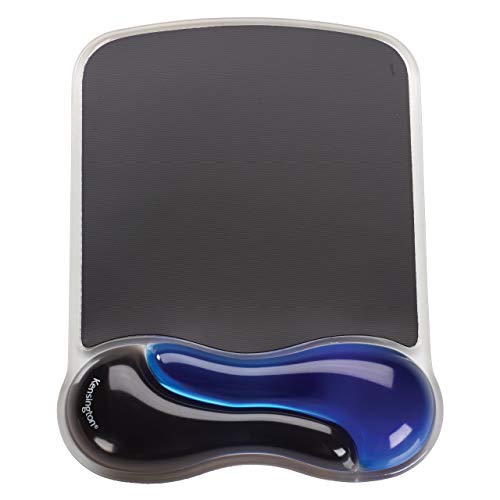
Kensington Duo Gel Mouse Wrist Rest
An ergonomist-approved dual-gel mouse pad with a ventilation channel to keep hands cool and dry, a durable vinyl mouse surface for fast tracking, and a 2-year warranty.
FAQ#
How high should a keyboard wrist rest be?#
About level with your keyboard's front edge, measured from the desk to the top of the bottom row of keys. That keeps your wrist roughly straight. For soft foam, choose slightly taller to account for compression; for firm gel, aim close to exact. If your wrist bends upward when your palm is on the rest, the rest is too tall.
Should a wrist rest touch your wrist or your palm?#
Your palm. Most ergonomic guidance recommends resting the heel of the palm on the pad, not the soft underside of the wrist, where tendons and the median nerve run. Position the rest so your palm lands on it naturally when your fingers are on the home row.
Do I need a wrist rest for a low-profile keyboard?#
Often not, because a low-profile board sits close to the desk and your wrist stays fairly straight. If you notice the desk edge pressing into your hand, or your wrist bends up slightly, a thin rest like an 8 mm palm rest fills the small gap. A thick rest would make things worse.
How long does a wrist rest last?#
It depends on firmness and cover. Firm gel generally holds its shape longer than low-density foam, and stitched edges resist fraying. Replace a rest when it no longer springs back, has visibly flattened where your palms sit, or the cover is torn or stained. Daily-use foam pads often need replacing every year or two.
A wrist rest is a comfort and posture tool, not a medical treatment. If you have ongoing numbness, tingling, or pain in your hands or wrists, see a doctor.
Ready to compare specific models? See our ranked wrist rest reviews.