The pitch for a walking pad is irresistible: burn calories while you answer email. But how many calories are we actually talking about — enough to matter, or a rounding error? The honest answer is that a walking pad burns real, useful calories, just not the headline numbers the machine's display likes to show. Here's the math, calibrated to reality, so you know what you're actually getting per desk mile.
The Formula That Governs It#
Calorie burn from walking comes down to one equation built on METs — metabolic equivalents, a standard measure of energy cost. The formula is:
Calories per hour = MET value × your bodyweight in kilograms
The Compendium of Physical Activities, the standard reference researchers use for these values, lists level treadmill walking at about 3.0 METs at 2 to 2.4 mph, 3.8 at 3 to 3.4 mph, and 5.8 at 4 to 4.4 mph. To convert your weight, divide pounds by 2.2. So a 160 lb (73 kg) person walking at 3 mph burns roughly 3.8 × 73 = 277 calories per hour. That's the number before any of the optimistic adjustments a treadmill display tacks on.
What You'll Actually Burn Per Hour#
Here's the realistic range by speed and bodyweight, using the MET formula above:
- 130 lb (59 kg): ~175 cal/hr at 2 mph, ~225 at 3 mph, ~340 at 4 mph
- 160 lb (73 kg): ~220 cal/hr at 2 mph, ~275 at 3 mph, ~425 at 4 mph
- 190 lb (86 kg): ~260 cal/hr at 2 mph, ~325 at 3 mph, ~500 at 4 mph
- 220 lb (100 kg): ~300 cal/hr at 2 mph, ~380 at 3 mph, ~580 at 4 mph
The pattern is clear: speed matters more than anything, and heavier bodies burn more for the same pace. A typical desk worker strolling at 2 mph during calls is looking at roughly 175–300 calories an hour — not dramatic per hour, but it compounds.
One honest adjustment: these are gross figures. They include the roughly 1 MET your body burns just sitting quietly (Compendium of Physical Activities), so the extra burn from walking instead of sitting is about one MET lower — subtract your weight in kilograms per hour.
Why the LED Display Overstates It#
Walking pad consoles often read high. First, many budget pads estimate calories from time and speed alone and never ask your weight, so they assume an average user who may be heavier than you. Second, a console shows gross calories, which makes the walking itself look like it earned the calories you'd have burned sitting anyway. Third, manufacturers have no incentive to under-promise. Treat the display as a motivational toy, not a food diary — the MET math above is closer to the truth.
The Real Advantage: Volume, Not Intensity#
A walking pad won't out-burn a hard gym session per minute. Its superpower is duration you wouldn't otherwise get. You can't jog for three hours during your workday, but you can absolutely walk slowly for three hours while you work. Two to three hours of 2 mph walking spread across a day adds roughly 250–600 calories above what you'd burn sitting still, depending on your weight — every workday, with effectively zero willpower cost. Over a month that's the kind of consistent, low-effort deficit that actually adds up. If you want to see the models people actually stick with, our under-desk treadmill reviews rank them by motor, noise, and price.
For long, slow walking sessions, a low-profile pad that slides under your desk is the easiest kind to keep using every day.

Sunny Health & Fitness Treadpad 100 (SF-T724064)
Editor’s ChoiceOne of the most popular walking pads, with a large owner base. A no-assembly, slide-under-the-desk slab with Wi-Fi and Bluetooth SunnyFit app tracking, a 41-inch deck, shock-absorbing cushioning, and a remote — the safe default for a home office.
Three Ways to Burn More Without Trying Harder#
Add a little incline. The Compendium of Physical Activities rates uphill walking at a 1 to 5 percent grade at a moderate-to-brisk pace at about 5.3 METs, versus 3.8 for level walking at a moderate pace — roughly 40% more energy, with little change to your ability to type at slow speeds. Pads like the Superun BA10-B build this in, and it's the single highest-leverage upgrade if burn is your goal.
If you want incline built in, this is a compact pad with a manual incline setting.
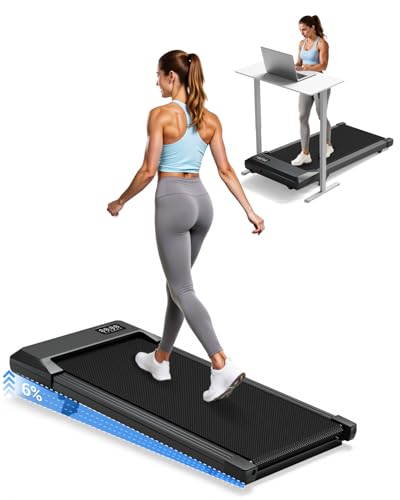
Superun BA10-B Walking Pad with Incline
The best budget incline pad. At 35 lbs with a 6% manual incline, a 2.5HP motor, 300 lb capacity, and a 5-layer shock belt, the Superun BA10-B adds calorie-burning incline and PitPat app tracking at a budget price while staying under 45 dB for calls.
Walk longer, not faster. Above 3 mph your stride lengthens and typing accuracy drops, so you'll bail sooner. Slower-but-longer beats faster-but-shorter for total daily calories — and it keeps you under the ~45 dB noise threshold that makes calls bearable.
Stack it onto things you already do. Take every phone call, every Slack huddle, and every long read on the pad. Anchoring walking to existing habits is what turns a novelty into a daily habit worth several hundred calories.
The Bottom Line#
A walking pad burns roughly 175–375 calories an hour for most people at a desk-friendly 2 to 3 mph — less than the console claims, but real, and available for hours a day at almost no effort. The win isn't intensity; it's the sheer volume of low-grade movement you can fold into a workday you were going to spend sitting anyway. Pick a quiet pad you'll actually use, add a touch of incline if you want more, and let consistency do the work. For the full breakdown of which pads are worth buying, see our complete walking pad buying guide.