Choosing a desk organizer comes down to three things: what kind of clutter you actually have (writing tools, paper, or small loose bits), how much desk surface you are willing to give up to hold it, and how often you reach for each item, which decides whether it belongs in an open slot or behind a drawer. Sort those out first and the right shape of organizer becomes obvious; skip it and you end up with a handsome caddy that holds the wrong things.
Want our ranked shortlist? See the best desk organizers.
Before You Buy: Audit the Desk#
An organizer is a home for stuff you already own, so start with the stuff, not the store.
Empty and Sort#
Clear everything off the desk surface and sort it into four piles: writing tools (pens, markers, scissors, rulers), paper (mail, notebooks, printouts, folders), small loose items (clips, sticky notes, USB sticks, earbuds, chargers), and things that do not belong on a desk at all. That last pile goes elsewhere. Whatever is left is what your organizer has to hold, and the size of each pile tells you which kind of storage you need most.
Sort by Reach Frequency#
Within each pile, split items into daily, weekly, and rarely. Daily items earn an open slot within arm's reach. Weekly items can live in a drawer or a back tier. Rarely used items should not take desk space at all. This one step prevents the most common failure: a drawer full of pens you grab twenty times a day, or an open cup full of things you touch once a month.
Set a Footprint Budget#
Decide how much desk you will give up, and measure it. Most people dedicate a back corner or the strip beside the monitor. For scale, a mesh pen cup like the Amazon Basics model is about 3.7 by 3.3 inches, the SKYDUE rotating caddy about 5 by 3.8 inches, the EasyPAG mesh caddy 8.7 by 4.9 inches, and the Vtopmart stackable drawers 12.1 inches wide. Measure the depth too: a file organizer with upright sections needs real front-to-back room, and the Simple Houseware file organizer, for example, takes a fair amount of desk depth.
Check Vertical Clearance#
Organizers that build upward save surface area but need height. Note what is above and behind your chosen spot. A tall letter tower can block the lower edge of a monitor, block a window, or sit in the path of a desk lamp arm. The Simple Trending 7-tier organizer is a good example: it holds a lot of paper but is tall enough to block a low-mounted monitor.
The Decision Axes#
Open vs Enclosed#
Open storage (cups, caddy slots, upright files) is fastest to use and easiest to put things back into, which is why it works for daily items. The downside is visual noise; everything is on display. Enclosed storage (drawers, lidded boxes) hides clutter and keeps dust off, but adds a step every time, and things put away behind a drawer tend to be forgotten. Most well-organized desks use both: open for daily, enclosed for weekly.
Horizontal Tiers vs Upright Files#
Paper can be stored flat in stacked letter trays or upright in file sections. Flat tiers suit loose sheets, mail, and forms you process; each tier becomes a stage like "to do," "waiting," and "done." Upright sections suit notebooks, folders, and anything with a spine you want to pull out by label. If you mostly handle loose sheets, go horizontal; if you mostly handle folders and notebooks, go upright.
Single Unit vs Modular#
An all-in-one unit with slots, trays, and a drawer keeps everything in one footprint and looks tidy. A modular system of separate cups, trays, and stackable drawers lets you rearrange and add pieces later. The all-in-one wins on small desks and for people who want one purchase. Modular wins when your needs are still changing or you want to split storage between two sides of the desk.
Material#
Steel mesh is durable and rust-resistant when coated, but it shows what is inside and small items can slip through the gaps. ABS plastic is light and inexpensive, though thin partitions and small drawers are where it feels flimsiest. Clear acrylic shows contents at a glance and looks clean, but it can scratch over time. Wood looks warmest on a visible desk and hides contents completely.
Stability#
Anything you pull a pen from or slide a drawer out of needs to stay put. Look for non-slip pads or a base wide enough not to tip. Rotating organizers need a firm non-slip base so the whole unit does not travel when you spin it; the SKYDUE caddy pairs its 360-degree spin with a non-slip pad for this reason.
Budget Tiers#
Budget. Single pen cups, small mesh caddies, and lightweight tiered organizers with tool-free setup. You get a home for writing tools and a few small items. You give up some rigidity and drawer quality; small drawers and lightweight frames are the usual compromise.
Mid-range. Coated steel mesh organizers with several tiers plus a sliding drawer, multi-tier letter trays with reinforced frames, and clear stackable drawers. You gain capacity in a contained footprint, sturdier construction, and the option to expand later.
Premium. Solid wood or bamboo organizers, matched modular sets, and larger all-in-one desk systems. You gain a finish that suits a visible desk and better drawer hardware. You pay mostly for materials and looks rather than extra storage.
Common Mistakes#
- Buying before sorting. An organizer bought before you know what you need to hold usually ends up holding the wrong things, or nothing.
- Oversizing. More compartments than items means empty slots that slowly fill with junk. Size the organizer to the clutter you have after the audit, plus a little room to grow.
- Hiding daily items. Putting the pens you use constantly in a drawer guarantees they end up loose on the desk again.
- Ignoring the small stuff that falls through. Mesh organizers let paper clips, SIM tools, and thin cables slip out. Keep those in a solid-bottom compartment or a drawer.
- Letting paper trays become archives. Letter trays are for paper in motion. If a tray holds papers you have not touched in months, file them or recycle them.
- Using a desktop organizer for cables. Desktop organizers are poor at cable management. Routing and clips do that job better; see our cable management reviews.
Picks by Need#
These map to the common situations above. For full rankings, use the review page.
Your clutter is a mix of pens and small supplies. The Marbrasse caddy has six open slots, two transparent drawers, a top tray, and a notebook holder, with no assembly. It suits a desk that needs one compact unit for daily tools and small loose items.

Marbrasse Pen Organizer with 2 Drawers
A multi-functional ABS desk caddy with open compartments, 2 transparent drawers for hidden storage, a top tray, and a notebook holder — no assembly required.
Pens are your only problem. The Amazon Basics mesh pen cup is powder-coated steel at about 3.7 by 3.3 inches. It suits a desk with light clutter where writing tools just need a fixed home.
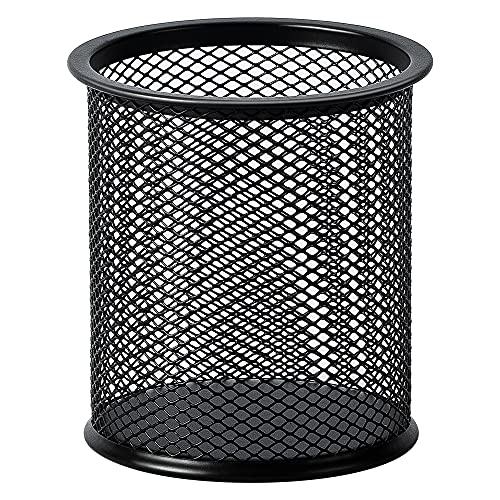
Amazon Basics Wire Mesh Pen Holder
Best ValueThe most-reviewed pick here — a durable powder-coated black steel wire-mesh pencil cup with a double-rimmed cone design that holds pens, scissors, rulers, and more.
You are tight on space but have lots of small items. The SKYDUE rotating organizer packs five compartments into about 5 by 3.8 inches and spins 360 degrees on a non-slip base. It suits a deep corner where back slots would otherwise be hard to reach.

SKYDUE 360° Rotating Pen Organizer
A space-saving 5-compartment rotating caddy with a 360° spinning base, non-slip pad, and a modern beige design that suits offices, kitchens, and classrooms.
Paper and files are taking over. The gianotter 4-tier organizer combines four mesh trays, a magazine rack, two hanging pen holders, and a sliding drawer in coated steel. It suits a small desk that handles regular paperwork and wants it stacked vertically.

gianotter 4-Tier Desk Organizer with Drawer
A compact 4-tier mesh organizer with a magazine rack, two hanging pen holders, and a sliding drawer — vertical storage that keeps a small desk clear.
You want enclosed, expandable storage. The Vtopmart clear stackable drawers come as a two-pack in BPA-free acrylic with non-slip pads. They suit someone who stores a lot across categories and wants to add tiers over time.

Vtopmart Clear Stackable Drawers (2-Pack)
BPA-free clear acrylic stackable drawers with pull-out handles and silicone non-slip pads — ideal for desk, vanity, bathroom, or pantry organization.
FAQ#
Where should a desk organizer go on the desk?#
Put it on the side of your dominant hand, just outside the area where your keyboard, mouse, and forearms move. Daily items should be reachable without stretching or twisting. Tall organizers belong at the back edge or beside the monitor, where they will not block your screen or your light.
How many compartments does a desk organizer need?#
Count the categories left after you sort your desk, then add one or two spare compartments for growth. Writing tools usually need one or two upright slots, small loose items need at least one enclosed compartment or drawer, and paper needs its own tray or file section. More compartments than that tends to collect clutter.
Should I choose a rotating or a tiered organizer?#
A rotating organizer suits many small items in a small footprint, especially in a corner where you would otherwise have to lean to reach the back slots. A tiered organizer suits paper and flat items that need their own level. If you have both kinds of clutter, a tiered unit with a drawer covers more ground than a rotating caddy.
Are mesh desk organizers good for small items?#
Mesh works well for pens, scissors, and anything larger than the gaps, but small items like paper clips and thin cables can slip through. If small items make up most of your clutter, pick an organizer with solid-bottom compartments or a drawer, or pair a mesh unit with a small enclosed box.
Ready to compare specific models? See our ranked desk organizer reviews, and if a riser with built-in storage might suit you better, check the desk shelf reviews.