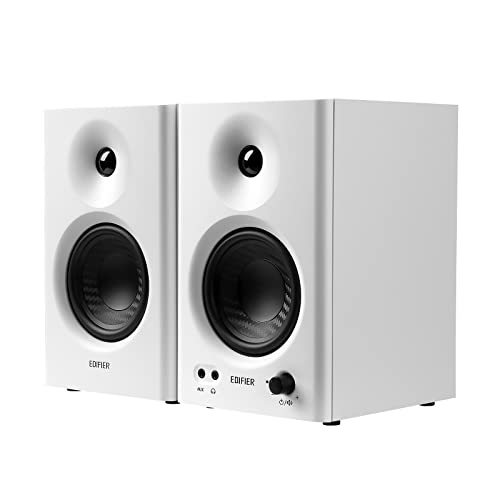
Quick verdict: Buy the Edifier MR4 if you want slightly larger woofers and a switchable music mode for when you are not working on audio. Buy the PreSonus Eris 3.5 if you want a smaller pair from an established studio brand with a clearly stated 50 watts of amplification and a neutral, studio-first tuning. Both are wired, near-field monitors with nearly identical inputs and a front headphone jack; neither has Bluetooth.

- Type
- Active studio monitor
- Powered studio monitors (pair)
- Drivers
- 4 in woofer + 1 in tweeter
- —
- Inputs
- TRS, RCA, AUX
- TRS / RCA / AUX
- Headphone out
- Yes
- —
- Modes
- Monitor / Music
- —
- Driver
- —
- 3.5" woven composite
- Power
- —
- 50W Class AB
- Near-flat studio tuning
- Balanced TRS + RCA + AUX inputs
- Front headphone output
- No Bluetooth
- Analog-only — needs an interface or headphone jack
- Accurate, flat studio-monitor sound
- 50W Class AB, improved woofers
- Auto power-saving mode
- Sold as a powered pair, takes desk space
- Neutral tuning isn't bass-forward
Woofer Size and Desk Footprint#
The most concrete difference is the driver size. The Edifier MR4 pairs a 4-inch composite woofer with a 1-inch silk dome tweeter in each speaker. The PreSonus Eris 3.5 uses a 3.5-inch woven-composite woofer with a 1-inch silk-dome tweeter, and PreSonus lists its frequency range as 80 Hz to 20 kHz.
A larger woofer generally has an easier time producing fuller low end at desk volumes, which gives the MR4 a small edge on paper for bass. The Eris 3.5's smaller cabinets are easier to fit on a crowded desk or beside a monitor. If space is tight, that matters as much as the half inch of woofer. Neither pair will replace a subwoofer for deep bass, and the Eris's neutral tuning is deliberately not bass-forward.
Tuning: Monitor Mode vs Studio-First#
Both are designed as studio monitors, meaning a flatter, more honest sound than typical consumer speakers. Edifier says the MR4 is tuned to a near-flat response curve for artists and music creators, and its MDF wooden cabinets are meant to reduce resonance.
The MR4's distinctive feature is a dual-mode design. A front-panel knob sets volume and switches between Monitor mode, for accurate listening during production, and Music mode, a more relaxed voicing for everyday listening. If your speakers do double duty for mixing and for background music, that switch is genuinely convenient.
The Eris 3.5 sticks to studio tuning. PreSonus positions it for music production as well as gaming, movies, and streaming, but it does not offer a separate listening mode. Its sound is neutral, so music will sound accurate rather than hyped.
Tone Controls and Power#
Both pairs give you rear high- and low-frequency controls to compensate for your room and placement. On the MR4 these are two separate knobs for high and low frequencies. PreSonus describes the Eris 3.5's equivalent as acoustic tuning controls that let you tailor the sound to your space without acoustic treatment. In practice they serve the same purpose: trimming bass if the speakers sit near a wall, or taming brightness in a hard-surfaced room.
PreSonus rates the Eris 3.5 at 50 watts of built-in amplification for the pair, which is plenty for a desk at normal listening distance.
Inputs and Connections#
The two are almost identical here, and both are analog-only. The MR4 has a 1/4-inch balanced TRS input, an unbalanced RCA input, an unbalanced AUX input, and a front headphone output. The Eris 3.5 offers balanced TRS, RCA, a front-panel aux input, and a front headphone jack.
That means either pair connects to an audio interface, mixer, computer, phone, or game console, with balanced TRS being the best option if you have an interface. Note that the Eris 3.5 discussed here is the standard wired model, not the Bluetooth version, so neither pair streams wirelessly. If you want Bluetooth, you will need a different model or an external receiver.
Who Should Buy Which#
Choose the Edifier MR4 if you:
- Want 4-inch woofers for a little more low-end presence
- Use the same speakers for production work and casual listening
- Like having separate high and low frequency knobs plus a front-mounted mode switch
Choose the PreSonus Eris 3.5 if you:
- Need the smaller footprint on a crowded desk
- Want a strictly neutral, studio-first sound
- Prefer a long-established studio monitor brand with a clearly stated 50 watt rating
Frequently Asked Questions#
Which is better for music production, the Edifier MR4 or PreSonus Eris 3.5?#
Both are suitable entry-level near-field monitors with near-flat tuning and balanced TRS inputs for an audio interface. The Eris 3.5 keeps to a single studio voicing, while the MR4 adds a Music mode for casual listening. For mixing, use the MR4 in Monitor mode or the Eris as-is.
Do the Edifier MR4 or PreSonus Eris 3.5 have Bluetooth?#
No. The Edifier MR4 and the standard PreSonus Eris 3.5 are both wired, analog-input monitors. PreSonus sells a separate Bluetooth version of the Eris 3.5, but the standard model has no wireless connection.
Do both have a headphone jack?#
Yes. The Edifier MR4 and the PreSonus Eris 3.5 both include a front-panel headphone output for private listening, alongside a front aux input.
Which has more bass?#
The Edifier MR4 has the larger woofer, 4 inches versus 3.5 inches on the Eris 3.5, which gives it a slight advantage in low-end fullness at desk volumes. Neither is designed to be bass-heavy, and both offer a low-frequency control to adjust bass for your room.
The Verdict#
These two are closer than most comparisons: both are compact, wired studio monitors with silk dome tweeters, balanced inputs, tone controls, and a front headphone jack. The Edifier MR4 edges ahead for people who want slightly bigger woofers and a one-knob switch into a more relaxed music mode. The PreSonus Eris 3.5 suits smaller desks and anyone who wants a straightforward, neutral studio sound. Pick by desk space and how often you listen for pleasure rather than work, and see our full desk speaker reviews for more options.
Where to buy